
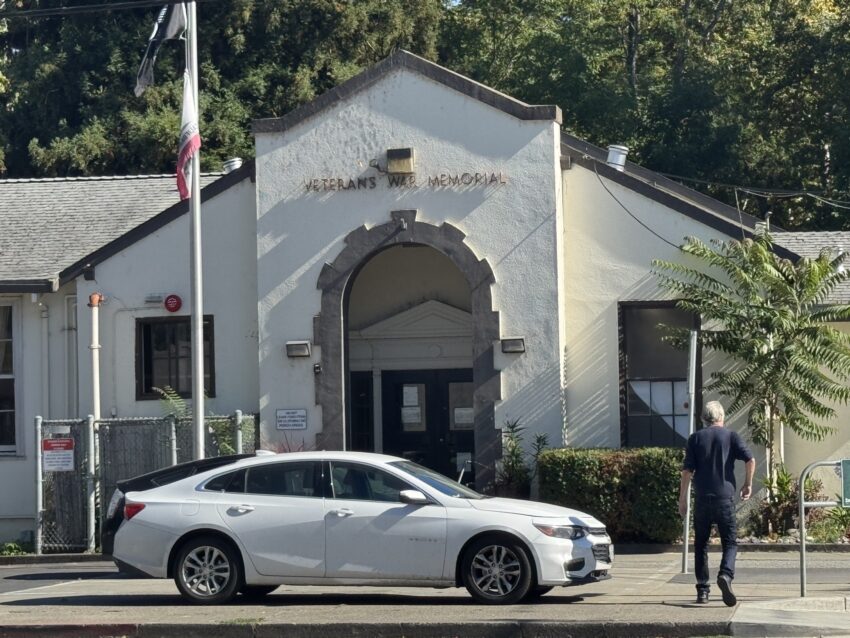
Every town needs a place to meet. Ours is the Veterans Memorial Building at First and Church.
On Wednesday afternoon, Oct. 14, the county sent me what I asked for in August under the state’s public records law: more than 50 files on the hall. They include the engineers’ report I had only seen summarized, the ledger for the money set aside to plan the hall’s future and the emails behind the shelter’s rent.
In 1964, when the river came up to 47.4 feet, 400 Guerneville residents spent Christmas in a shelter. Through the floods after that, the vets hall was where people went, until the Valentine’s Day flood of 1986 put the water close enough that everybody had to move out of it. In 2019 it opened as an evacuation center and the river ran them out again — up the hill to St. Hubert’s, then to St. Elizabeth’s.
River to Coast Children’s Services started running Kindergym in the auditorium in 1976 — parents on the floor with children under 5, two mornings a week, for 50 years. The Sisters called bingo there, 250 people in the room on a good night, thousands of dollars a night going to a local nonprofit. The bingo had to move to Santa Rosa. Sonoma County Vet Connect put in showers for people who did not have any.
And the dinners. The Guerneville Community Thanksgiving Dinner ran in that hall from noon to 4 p.m., free, 400 or 500 people in a good year, about $7 a plate to put on. Penny Rivas organized it for 15 years, for homeless and disadvantaged people and anybody else in town who wanted to come. At Christmas the Sisters ran the Community Holiday Dinner in the same room, a job they took over from the Chamber of Commerce around 2001. In 2014 they served more than 500 people with 40 volunteers, two truckloads of toys, and 55 hams and turkeys.
A man named Richard, homeless, who would not give his last name, described the room to a reporter that year. “It’s come as you are,” he said. “It feels good to be accepted.”
The hall is also the shelter. Not the winter shelter — the shelter. For more than a decade it was a winter operation: Dec. 1 to March 31, doors open at 5 p.m., everybody out at 7 a.m., 20 beds in the winter of 2009. It moved around town before that, a church hall one year, the vets hall the next, and then it settled. During the pandemic the county stopped closing it in the spring and never went back to closing it. By November 2022 the county’s own shelter list described it as year-round, capacity 27, expanding by eight for the winter. Today West County Community Services runs it around the clock and takes it to 35 or 45 beds when the weather turns.
Here is the part I think this town needs to say out loud: the shelter is fine.
It is fine that our hall is a shelter, and fine that we have a year-round shelter. When the county went looking for a permanent site on Armstrong Woods Road in 2017, the fight split the town, and the $1.2 million set aside in 2013 for a year-round facility is still sitting there, unspent. We have one of the larger homeless populations in the county and no purpose-built place for it. People died in the meantime. Buck Muth died at 67, found under the footbridge spitting up blood after sleeping outside in the rain.
The hall has been feeding people with nowhere else to go for decades — Thanksgiving and Christmas, housed and unhoused at the same tables, the toy drive going in the corner. The shelter didn’t change what the room is for; a shelter is what the room has always been.
People keep telling me George’s Hideaway will take care of this. Nope. The confusion is worth clearing up.
George’s Hideaway is 21 apartments — studios plus a manager’s unit, on Highway 116 where the old tavern was. It is permanent supportive housing: leases, not cots. The units fill through the county’s coordinated entry system, which is a countywide list, not a Guerneville one. A navigation center and a peer behavioral health program are part of the plan for the site, and those will serve people who don’t necessarily live there. All of that is good.
But it’s not a shelter, and it adds no emergency beds. Twenty-one households get homes. Nothing about the Hideaway opening changes what happens on a cold night in December.
The problem with the Vets’ building is the building. In August 2020 the people who run the shelter closed it and opened an outdoor site at the Park N Ride for 25 people, drawn from the shelter and from downtown. Their explanation is still on their website: the Veterans Building “is extremely hot during the summer,” has “poor air circulation,” and because of it “fewer homeless citizens have been staying at the shelter, opting to stay outside.” The operator moved people out of the hall and into a parking lot.
In 2019 the county paid for an assessment. The hall went up in 1957 and, in the county’s language, “appears to have been constructed over vegetative matter” — built on fill that decays. A floor survey found settlement “throughout the entire building.” The foundations are “inadequate to transfer lateral forces from the building to the ground in a seismic event.” The building sits in a flood hazard zone. There is dry rot and water damage in the timber framing, worst in the basement, and county staff wrote that the framing “will continue to deteriorate with repeated exposure to moisture.”
The report itself runs 129 pages, from ZFA Structural Engineers, dated Aug. 16, 2019. Its first high-priority finding is about the ground. The site is “highly susceptible to liquefaction,” with settlement estimated at 8 to 13 inches, and “settlement of this magnitude will likely render the building un-occupiable after a seismic event.”
Bringing it up to seismic code was priced at $1.32 million in 2019, before whatever the work uncovered. With finishes, a roof, accessibility and the parking lot, the figure was $5,534,000 — closer to $7 million at 2022 prices. Everything ever put on the list for the building comes to more than $12.7 million.
In September 2021, county staff told the Board of Supervisors not to fix it but to plan its replacement: consider “whether continued investment in this facility for its current uses is warranted,” they wrote, and consider “demolition and rebuild, or relocate to a different location.” Staff suggested $160,000 for that planning, out of Measure L — the hotel tax, which sets aside 9 cents of every dollar it collects for veterans buildings.
On Sept. 14, 2021, the board approved it unanimously — Gorin, Rabbitt, Coursey, Gore and Hopkins, by resolution, at the four-fifths threshold a midyear budget change requires. The vote is hard to find: the minutes were approved but the county never posted the document, so from the outside the item reads blank.
In August I asked Supervisor Lynda Hopkins whether the money was ever spent and whether anything came of it.
“It was,” she said.
The money was her doing, she said, going back to 2018 or 2019, watching Measure L dollars go to other towns’ halls. “Why is this money all going up to Cloverdale or south of Petaluma or to the Santa Rosa vets building? And we get nothing out in West County.”
What she learned was that General Services, the county department that runs the buildings, had already written the hall off. “General Services had essentially made the determination that the building eventually is going to be condemned,” Hopkins said. “The thing needs to be demolished and replaced. That was the conclusion that General Services had come to. But they had never really publicly informed the board of that fact.”
The $160,000 was her answer: if the county would not spend on the building, it could spend on figuring out the alternative. The planning happened. The county studied sites — the library, the Catholic church property, “a whole bunch of different potential building sites” — and concluded, in her words: “The best site for the Veterans Building rebuild is the Veterans Building.” The county then brought in Praxis Architects to look at a new sheriff’s substation and community building on the site. “We do have some drafts,” Hopkins said.
Nothing was charged to the $160,000 until Aug. 1, 2024, almost three years after the vote, the county’s ledger shows. By Aug. 24 of this year the county had spent $136,184.30, nearly all of it with Praxis Architects of Monte Rio.
The contract, from 2023, is for a feasibility study and schematic design of a “New Western Emergency Resource Center” on First Street. Its list of needs: a sheriff’s substation, beds for six to eight firefighters, nine vehicle bays, an emergency operations center, room for cots, a generator and a fuel station. The veterans’ space is “to be determined.” The drawings weren’t in what the county sent me.
There’s also a possibility of a community building at the Park N Ride, as part of a parks project carrying $1.5 million in Ag + Open Space funding and a design Guerneville Elementary students worked on — the same lot the shelter moved people to in 2020.
The problem is money. “The biggest problem is that this is going to be hugely expensive, and we don’t have a funding source identified for the rebuild of that building,” Hopkins said. She is hoping for state or federal funds. “Both the state and the feds have really turned off the tap in terms of funds for these kinds of things. But that’s what we’re hoping for someday.”
I asked about the old church campus the school district bought. She could not remember whether the study looked at it. The barrier there is the bridge over the creek, expensive to replace to current standards, on ground that floods first.
The county’s tally of hotel-tax money spent on veterans buildings from 2021-22 through 2025-26 comes to about $3.5 million. Petaluma’s seismic retrofit drew $513,235 one year and $423,136 another. Guerneville’s only line is the $160,000.
The 2021 staff report recommended $1.5 million for Petaluma’s veterans hall, seismic work and a new roof. On March 3 of this year the board bought Cloverdale’s hall a generator. On April 7 it accepted a $500,000 state grant for Cloverdale’s hall on consent, moved by Rabbitt, seconded by Gore, approved by resolution without discussion. Item 7 the same afternoon was a $138,588 rental fee waiver for West County Community Services’ navigation site and homeless shelter — the rent the operator of our shelter pays the county. The board continued it to a date to be determined.
That afternoon a county budget official emailed Hopkins and other county staff that the waiver was “not needed” because the rent was already funded through June, and that the county “cannot allocate funds at this time” for future years. Hopkins wrote back the same day, in an email released with the records: “Prior to the pandemic, the shelter was seasonally operated and only overnight; it made sense to charge rent then because there were other community uses of the building also taking place, which were also charged fees. The unsheltered community was sent out into downtown around 7am each morning, and the place was scrubbed down with bleach and set up for Kindergym. Russian River Sisters Bingo, town halls, and other community meetings were also hosted at the Vets Building in prior years. Now it is solely a homeless services site and shelter.”
The 24/7 shelter started in the pandemic at the county’s request, she wrote, “and we’ve been robbing Peter to pay Paul for rent ever since.”
When I talked to her in August, she said the fix was coming. “It really doesn’t make sense to charge them and then have them try to apply for grants to pay for the lease when they’re providing a public service for the community,” she said.
On Sept. 1 the board approved that fix, on her motion, seconded by Supervisor James Gore. West County Community Services now holds a license to use the hall with no rent; its services under its county contract are the payment. The county is putting $138,828 into upkeep this fiscal year. The license runs through next June, with up to four one-year extensions at the discretion of the county’s public infrastructure director.
Under the license, the county “shall not be obligated to make structural repairs or capital replacements, including replacement of mechanical systems or the roof.” The shelter operator acknowledges that “the Premises are old and experiencing deterioration.” To grant the license, the board found the building “will not be needed for county purposes” while it runs.
In August, Permit Sonoma told me the building is safe to occupy, citing an inspection it did under a state law known as AB 130, at the request of the county health department. The license says that if a substandard condition turns up, the county “shall be under no obligation to expend funds to comply with the requirements of AB 130” and may end the license on 10 days’ notice.
Meanwhile the county is spending real money in Guerneville — $815,000, up to $896,500 with contingency, for a new roof, new heating and air and a new fire alarm at the old Bank of America building on Main Street. None of that is a scandal. The Bank of America building is now the West County Services Center, where you can see District 5, Health Services, Human Services and WIC without driving to Santa Rosa.
But the county has seven veterans halls, a maintenance backlog that ran to $20 million countywide, and it loses money on all of them. When it went looking for outside groups to take the halls over, Sebastopol had a taker and Sonoma had several. Nobody came forward for Guerneville.
The county has an advisory committee for its veterans buildings, with a representative for each hall. In May 2025, according to the minutes, Guerneville’s representative, Ken Holybee, told the committee: “I think I’ve been very patient, but I haven’t heard from anyone about what’s happening at the building.” A county analyst answered, “I don’t think there has been anything to report.” The county’s building report for Guerneville at that meeting read, in full: “Still a shelter.”
And you cannot book our hall. This summer the county’s own website said it “is currently rented by West County Community Services” and that “they do not take reservations to rent out the building to other parties.” Kindergym meets in Monte Rio on Tuesdays and Forestville on Thursdays. Bingo is in Santa Rosa — a Guerneville organization that has raised more than $2 million for this river, raising it over the hill.
When the Lower Russian River Municipal Advisory Council meets, the county notices it as hybrid: Suite B at the West County Services Center, or Zoom.
I asked Hopkins where a group in this town can hold a meeting. Suite B is free — “we don’t charge folks to hold meetings at the West County Services Center” — but “we don’t have the ability to just staff endless meetings,” so groups partner with the county or a community organization to use the room. For town halls she named the places the county goes. “We’ve had a lot of town halls at Guerneville Elementary over the years, and we have also had a lot of town halls at the Monte Rio Community Center. Those are kind of the main spaces in the Lower Russian River.” She also remembered a small community space at West County Health Centers.
A school gym, a room the county has to staff, a clinic space, and a community center in the next town down the river.
One more thing from the 2021 staff report. Closing or replacing the hall “will require compliance with the Military and Veterans Code, which in general requires a substitute facility be provided unless other conditions are met.” If they take our hall, they may owe us a hall.
I asked the county for any analysis of that requirement. The records it released this week contain none.
The county’s own records now hold a report that says the building will likely be unusable after an earthquake, a unanimous vote to plan its replacement, an architect’s contract for an emergency center, a license that promises no structural repairs and a law that may require a substitute facility. What is missing is the money.