
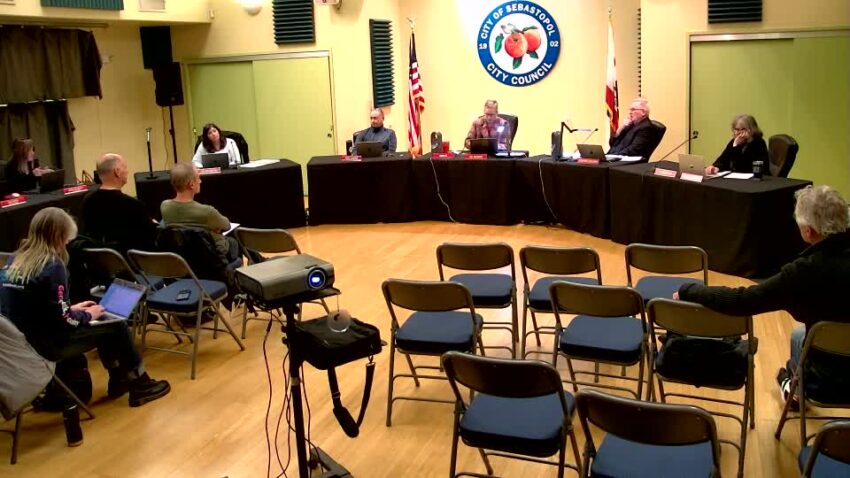
Money that Sebastopol water and sewer customers pay in will cover $467,779 less of City Hall’s costs this budget year, and the counter where they pay bills in person will be open mornings, 8 a.m. to noon, under a unanimous City Council vote on Nov. 17.
The staff report puts the cut at $159,069 for the water fund and $308,710 for the sewer fund. The city’s general fund picks up the difference. The city’s costs don’t go down. They move.
What the vote changes
Each year Sebastopol charges its water and sewer funds, which hold the money customers pay in, a share of City Hall’s costs. The vote changed the shares for four offices: the council, the city manager, the city clerk and administrative services. The budget adopted in June charged the water fund 24.3% of the council’s costs and the sewer fund 26.9%. The new shares are 17% and 13%. For administrative services, the two funds fall from 20.2% and about 23% to 12.5% each.
Staff based the new numbers partly on time logs. Administrative services staff logged about 745 hours of water and sewer work out of 5,080 hours from March through August, about 15%. For the council, city manager and clerk, staff went back through two years of council meeting recordings. They counted the time spent on water and sewer items.
Staff told the council the change is temporary and covers only the 2026-27 budget year. Staff said it reaches back to July 1, but the money moves in the midyear budget adjustment in January.
At the Nov. 17 meeting, Councilmember Stephen Zollman moved to adopt the staff percentages, and Mayor Jill McLewis seconded. Councilmembers Phill Carter and Neysa Hinton and Vice Mayor Sandra Maurer voted yes with them.
Why the city is doing this
In May, the Sonoma County Civil grand jury estimated that Sebastopol had overcharged its water and sewer funds about $5.5 million in overhead because it hadn’t updated the plan that sets those charges in more than 20 years. In its July 22 response, the city partly agreed. It said the old plan “may have resulted in overallocation” but that it hadn’t settled on a dollar figure.
Since then, according to the staff report, the council has suspended this year’s water rate increases and tiered water rates (July 7). It also forgave a $1.1 million general fund loan to the sewer fund (July 21) and returned $350,354 in city attorney charges to the two funds (Aug. 4).
Counter hours and the meter loan
The utility counter is now open 7:30 a.m. to 5 p.m., with a 30-minute lunch closure, and the staff report said shorter walk-in hours would give staff uninterrupted time for billing but wouldn’t cut staffing costs. Customers can still make appointments and use the payment drop box when the counter is closed.
Staff hadn’t proposed new hours. A caller suggested 8 a.m. to noon, Monday through Thursday, and Zollman wrote those hours into his motion. Staff will draw up a plan for telling customers. No start date was set.
The water fund will keep paying $288,480 a year toward a loan of about $4.9 million the council approved in December 2021 for energy equipment, about $2.2 million of which bought smart water meters. The city’s Enterprise Fund Oversight Committee had asked that the general fund cover those payments. The staff report says the meters are a water system cost.
What it doesn’t do
The vote doesn’t pay back earlier years. Staff’s recommendation called for the budget change “with no prior-year refund or repayment.”
Lee Mathias told the council by Zoom during public comment that “the last two years, by my calculation, you’ve overcharged ratepayers $1.6 million.” Taking repayment off the table, he said, “really just leaves one path, and that is a legal lawsuit against the city to recoup that money.”
Earlier the same night, the council hired Government Consulting Partners for up to $19,500 to write a new plan for those charges, with a final report due in February. The firm offered a review of the nine years the grand jury studied for up to $9,750 more. The council didn’t add it. Zollman asked staff to find out whether the firm knows of any city that has cut refund checks to individual ratepayers, and staff agreed to ask.