
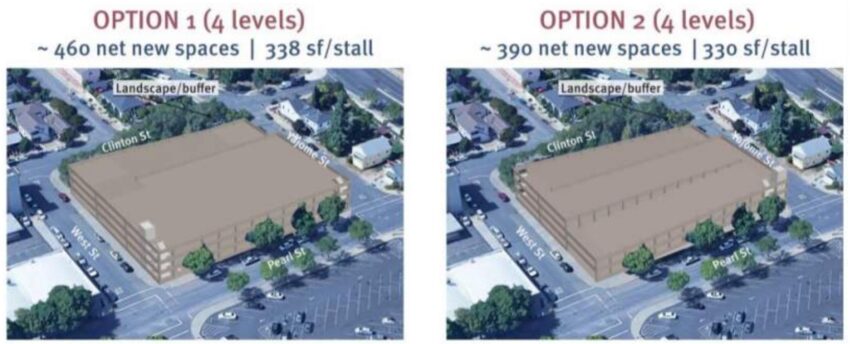
The skate park and playground on West Street in downtown Napa would go if the city builds a parking garage on the block. On Dec. 1, the Napa City Council will vote on buying the land for $4.1 million.
The block at 1210 West St. runs between West, Clinton, Yajome and Pearl streets. The Napa Sanitation District owns it. It holds a pump station the district no longer uses, a small park and a skate park, which the city runs under what the city’s staff report calls “a longstanding lease agreement.”
If the sale closes, the lease ends. The city would own the whole block.
What happens to the skate park
The city hired Walker Consultants to compare four downtown sites for a garage, and its feasibility study, dated Aug. 5, ranked the West Street block first. Under the heading “Displacement,” it lists the “Loss of play structure and loss of skatepark.”
The study says the skate park is “at the end of life, with a replacement already built at Kennedy.”
New play and skate facilities “could be relocated on site or to an adjacent location,” the study says. The nearby option would come with a redevelopment of the old Cinedome site at Pearl and West streets, a former movie theater that is now a surface parking lot. It also suggests extra land on the Clinton Street side could hold townhomes or “a replacement park-and-play structure.” The study offers both as options, not plans.
The study’s online survey drew 546 responses. Some written comments were about the skate park. “Keep the skatepark and the farmers market lot, for godssake,” one person wrote. Another wrote that “the skate park isn’t heavily used from what I’ve seen in the past 15 years.”
Where the $4.1 million comes from
The district and the city agreed the land is worth $5.2 million. The district takes $1.1 million off for the cost of tearing out and partly abandoning the old pump station. That leaves $4.1 million.
The money would come from a city fund the staff report describes as money “provided to the City to mitigate parking impacts from the Flood Control District projects in Downtown Napa.” The fund holds about $4,127,000. The purchase would use nearly all of it.
The city would put down a $205,000 deposit, refundable during a 90-day review period that can be extended by 60 days. In that time the city would test the site for contamination, and the price can change based on what turns up. The sale is expected to close within 15 days after the review ends, unless both sides agree otherwise.
How to weigh in
The purchase is on the council’s Dec. 1 agenda. The meeting starts at 3:30 p.m. at City Hall, 955 School St., and can be joined on Zoom. Written comments go to clerk@cityofnapa.org; the city asks that they arrive by noon on the meeting day.
How the city got here
The sanitation district’s board declared the block surplus land on July 17, 2024, in a resolution that let the district sell or lease it. On Feb. 3, the council told city staff to negotiate a purchase.
On Aug. 18, the council voted 5-0 to make the West Street block its preferred garage site and to move ahead with more detailed design work, according to the meeting minutes.
The study says a garage there could also provide the roughly 129 spaces the city owes the First Street hotel, and give the Napa Farmers Market parking and possible storage.
Part of the block’s east edge sits in the regulatory floodway until a planned floodwall is finished and FEMA revises its maps, the study says. A garage would have to sit back from Yajome Street.
The garage is a separate decision
Buying the block doesn’t approve a garage. The staff report says a surface lot or a garage would each need its own environmental review, funding decision and council vote.
The study estimates a garage on the site would add 390 to 460 parking spaces and cost $29.7 million to $34.3 million to build, plus about $260,000 a year to run. Those cost figures don’t include buying the land. The city has about $13.5 million in parking fees and other parking money, the study says.
That leaves $16 million to $21 million to come up with. To close that gap, the study lists paid parking, bonds, money from the city’s general fund and a downtown infrastructure financing district as possible sources.
At the August meeting, Councilmember Bernie Narvaez said he was concerned about how a garage would be paid for, the Napa Valley Register reported.