
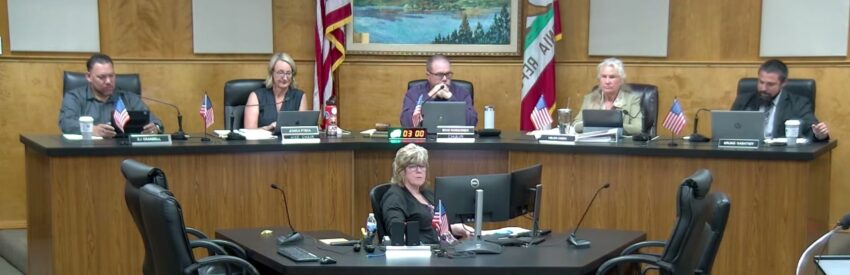
Lake County supervisors adopted the 2026-27 county budget Thursday, Oct. 1, a day before the state deadline. To balance it, they pulled the money for vacant jobs paid for by the county’s general fund.
The board voted 5-0 at a special meeting in Lakeport. A second 5-0 vote changed the county’s position chart to match. The adopting resolution puts total spending at $437.7 million, before the changes the board made Thursday.
The cuts lay no one off. They take the money from positions that are empty, so departments can’t hire into them. Supervisor Bruno Sabatier made the point during the debate: “This is not a layoff conversation. This is not a furlough conversation.”
Contingency fund drawn down
The board opened the budget hearing Tuesday, Sept. 29, and continued it to Thursday. Deputy County Administrative Officer Casey Moreno said the county had pulled almost $3.5 million out of contingencies, the money set aside for emergencies, to balance the budget.
Over the next two days, Moreno said, she and the one other budget analyst on staff went through every general fund budget and cut the salary money for each vacant position. That found another $1,189,791. Put back into contingencies, it still left them $2,280,485 short of where they had been.
Sabatier said contingencies have held $4.5 million in past years and $5.5 million lately, and he has never seen the county touch them.
“For us to use it just feels like we’re using reserves to balance our budget,” he said.
The board then canceled this year’s discretionary money, about $500,000 in cannabis tax revenue that supervisors hand out to community projects, and moved it into contingencies. Supervisors said money they had already promised would still go out.
The revised numbers reached supervisors by email at 7:30 p.m. Wednesday. They were posted to the meeting agenda Thursday morning. Sabatier pointed out errors in the reports. In one, total reserves read $123 million when the lines added to $125 million. In another, a sheriff’s fund was $11,000 off between two reports. Staff called that one human error from the short turnaround.
Sheriff warns deputies will be pulled off patrol
The unfunded list ran through the Sheriff’s Office: an accountant, a staff services analyst, an emergency services specialist, a deputy trainee, a sergeant, two dispatchers and a dispatch supervisor, a court security deputy and six jail corrections deputies.
Sheriff Luke Bingham said the changes “shifted the burden out of patrol to dispatch” and other jobs inside his office. His seven dispatchers worked 3,000 hours of overtime last fiscal year, he said, and the department has no overtime budget. Salary money from empty positions pays for it.
When a dispatcher calls in sick, he said, “I have to pull a deputy off the street and put him into that dispatch center,” because the county must staff its 911 center.
Jail hiring is slow, he said. A pool of 40 to 45 applicants might yield one hire. “I refuse to lower the standards,” he said.
Bingham said two corrections deputy candidates were in background checks. The board voted to fund two of the six jail positions, along with a probation aide and a probation program technician, both already filled. That put $289,544 back into the budget.
Sabatier said the across-the-board approach was not fair to the Sheriff’s Office.
“I don’t like what we are doing to our sheriff’s department because he happens to have the most vacancies,” he said. A department with no vacancies, he said, loses nothing.
Assessor gets a chief back in January
Assessor-Recorder Richard Ford said the cuts took both of his chief deputy positions and all but one of his deputy assessor-recorders. He called it effectively a 20% cut to the office that brings in the county’s biggest source of revenue.
Ford said a new state law raising recording fees, which takes effect in January, will pay for the positions without general fund money. The board agreed to restore one chief deputy starting Jan. 1. County Administrative Officer Susan Parker said that will take a resolution at the board’s first meeting in January.
Loans to be paid back
Sabatier asked that two departments start paying back loans from county reserves on a monthly schedule.
Building and safety owes $390,000. Sabatier proposed three years of payments, about $10,835 a month. Behavioral health owes about $2 million. Spread over seven years, he said, that comes to $23,810 a month. Both payments went into the adopted budget.
Behavioral Health Director Elise Jones said her department has drafted a repayment resolution, about $285,000 a year for up to seven years. She said the department is ready to pay this year’s full amount before the end of October and hopes to bring the resolution to the board Oct. 6.
Jones also said her department has put $278,274 back into its opioid settlement funds. About $1.9 million is still to be restored.
Bills on hold
Social Services Director Rachael Dillman Parsons urged the board to pass a budget. Without one, she said, her department couldn’t pay landlords in its housing programs, facilities caring for people under the public guardian, or its own rent and utilities.
Her department has held invoice payments since Sept. 21, she said, waiting on the county’s switch to new Workday accounting software. That switch was set for Oct. 1. “Workday go live has been indefinitely delayed,” she said.
Auditor-Controller Jenavive Herrington told the board no state law stopped the county from spending. The holdup, she said, is the overlap with the new accounting software. Her staff needed eight to 12 hours after the meeting to load the budget, which put payments at Monday at the soonest.
County Counsel Lloyd Guintivano said state law makes Oct. 2 a mandatory deadline for adopting the budget. He said his office found no specific penalty for missing it.
Board Chair Brad Rasmussen said the board had to pass a budget. Without one, he said, the county wouldn’t know what penalties it might face, what problems departments would have or whether its credit score would suffer.
Coming back in November
Supervisors set Nov. 17 to review the unfunded positions, including Sheriff’s Office jobs that carry grant money. They also plan a talk on the budget process itself, so numbers reach the board and the public earlier next year.