
Commercial cannabis growers outside Lake County’s cities would pay twice this year’s tax rate per square foot on next year’s crop unless county supervisors renew a 50% tax cut that runs out Dec. 31.
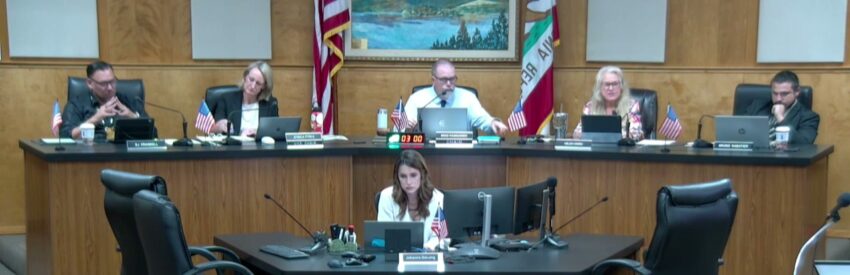
Treasurer-Tax Collector Patrick Sullivan has put the question to the Board of Supervisors for its meeting Tuesday, Nov. 17. “This reduction will expire at the end of this calendar year if your Board does not take any action,” Sullivan wrote in his memo to the board. He brought the item because of “inquiries to our office,” he wrote.
What growers pay now
Voters approved the cultivation tax as Measure C in November 2016. The ballot question set it at $1 a square foot for outdoor grows, $2 for mixed-light and $3 for indoor, “subject to annual Consumer Price Index increases,” yearly inflation increases. It applies to commercial grows outside city limits. The county expected it to bring in about $8 million in an average year.
Since 2022, supervisors have cut those rates in half. The latest renewal passed 5-0 on the consent calendar Dec. 16, 2025, the minutes show. It reduced the “original cultivation tax rates” by 50% for the 2026 tax year. It also kept taxing growers on canopy area instead of their whole cultivation area. When the county first made that switch in 2022, staff estimated it would shrink the taxed area by about 15%. And the resolution held off inflation increases for 2025 and 2026.
Growers pay the year after they grow. Payments come due Jan. 1 and May 1 of the next year, so tax on 2027 crops would come due in 2028.
3 choices
Sullivan’s memo gives supervisors three options:
Do nothing. The cut ends, and “next year taxes will be imposed at their standard rate.”
Adopt a resolution that sets a new percentage cut.
Set up a tiered tax with a break for small operators, “e.g. 50% reduction on operations of an acre or less; or a reduced rate for small retail.”
He asks the board only for direction. If supervisors want a change, his office would come back with the paperwork. The memo doesn’t say what the 2027 rate per square foot would be once inflation increases are counted.
What the county collects
Cannabis tax payments peaked at $8.3 million in the 2020-21 fiscal year, a 2024 county memo shows. They fell to $1.9 million in 2022-23. A county table puts 2024-25 at $3.4 million, not counting penalties.
In a budget memo for the same meeting, county administrators point to “known pressures on the General Fund, which had necessitated a hiring freeze.” The budget changes on Tuesday’s agenda ask for a sheriff’s dispatcher job, listed at $24,836 and paid with cannabis money. During budget hearings that ended Oct. 1, supervisors moved about $500,000 in cannabis tax money they usually give to community projects into a fund set aside for emergencies.
How the cut kept coming back
The board first cut the rate in half in April 2022, after cannabis prices crashed. In a 2024 memo, Supervisor Bruno Sabatier cited the Lake County Cannabis Alliance: outdoor cannabis sold for as much as $1,200 a pound in 2020, fell as low as $200 in 2021 and was “hovering under $400” in 2024.
The board renewed the cut in 2023, and again on a 4-1 vote in August 2024. Sabatier wrote then that “enough respite has been given to cultivators in Lake County that slowly rescinding some of these tax breaks should be on the table.” That 2024 resolution kept the 50% cut for 2025 but let inflation increases start again. The December 2025 resolution renewed the cut for 2026 and put inflation increases back on hold.
The case for letting it end
Two online comments on the November 2025 item, signed by Thomas Lajcik, urged supervisors to let the cut end. Citing a 2024 state Department of Cannabis Control market report, the comment says Lake County “currently has the lowest cultivation tax structure in the State, with a weighted average of about $1 per square foot.”
The other comment argues that renewing the cut year after year could break state law. Citing Proposition 218, it says changing how a voter-approved tax is measured makes it a new tax that voters must approve. “The County therefore cannot indefinitely extend the canopy-based calculation or reduced rate without violating both Measure C and State Law,” it says.
The county’s own resolutions say the voter-approved ordinances let supervisors amend them, as long as a change doesn’t raise the tax or widen it without a vote.
Seven people spoke on the tax at that Nov. 4, 2025, meeting, according to the minutes. The minutes don’t say what they said. The board told staff to come back with a resolution, and the renewal followed in December.
If you go
The board meets at 9 a.m. Tuesday at 255 N. Forbes St. in Lakeport and on Zoom. The cannabis tax item has no set time on the agenda.