
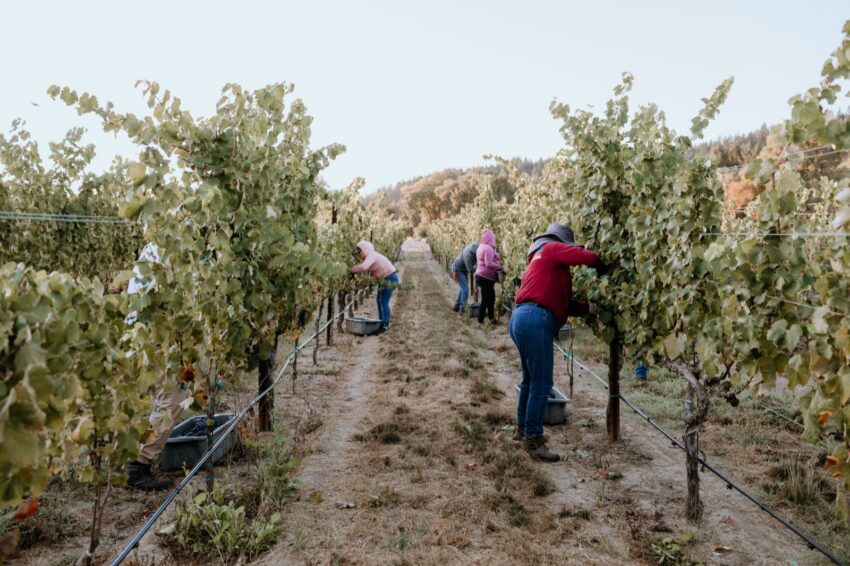
The first fruit of the 2026 vintage came off a Graton vineyard on Thursday, July 16 — nearly two weeks ahead of a start Sonoma County’s growers association once called one of the earliest on record.
Sonoma County Winegrowers, the marketing and educational group for a county with more than 1,800 grape growers, announced the start of harvest in a release Friday and said it “may be the earliest start in the region’s history.” The group also expects one of the lightest crops in years — and it’s not treating that as bad news.
“This is the earliest harvest I’ve experienced during my time with Sonoma County Winegrowers,” CEO Karissa Kruse said in the release. The smaller crop, she said, “will help bring supply and demand into better balance and strengthen the long-term outlook for Sonoma County growers, wineries, and the region.”
How early is early
The association’s own paper trail backs the claim.
A Sonoma County Winegrowers release dated Aug. 3, 2015, records the 2015 harvest starting “just after midnight on July 29,” when nearly 18 tons of pinot noir came off Vineyard Eleven on Starr Road in the Russian River Valley for J Vineyards & Winery’s sparkling program. That release called 2015 “one of the earliest on record” and noted the 2014 harvest had begun a day later on the calendar, July 30. The page no longer loads on the group’s site; it survives in the Internet Archive.
This year’s first pick beat both by nearly two weeks.
The Press Democrat reported July 16 that the first grapes came in at sunrise that morning from Dutton Ranch’s Jewell Vineyard in Graton — 12 tons of pinot noir headed to Schramsberg Vineyards — and called it the county’s earliest harvest in at least 40 years. WCG was not able to independently confirm that pick. Friday’s release from the growers’ association doesn’t name a first vineyard.
A warm March, a wet bloom, a light crop
The weather did this in two moves.
Above-average temperatures in early March pushed budbreak weeks ahead of schedule. Then cool, windy, rainy weather arrived during bloom, when the vines set fruit, and cost growers a share of the crop — shatter, the term the release uses for it. Fewer berries per cluster, smaller berries among the ones that held and a crop light enough that growers expect it to ripen fast.
Bret Munselle, owner and general manager of Munselle Vineyards in Alexander Valley, said in the release that early estimates on most of his cabernet blocks run “around 50-60% of our historic averages,” and that he expects to be three to four weeks ahead of last year.
“The quality should be excellent in 2026,” said Tyler Klick, a partner at Redwood Empire Vineyard Management and board chair of the growers’ group. “The harvest will start early and ripen quickly.”
Why a short crop counts as good news
A grower group cheering a light year sounds backward until you look at how much fruit the county has been delivering.
Growers in crush District 3, which covers Sonoma and Marin counties, delivered 186,846 tons in 2025, down from 214,426 tons the year before — a drop of about 13% — according to the final grape crush reports issued by the California Department of Food and Agriculture and USDA’s National Agricultural Statistics Service. Prices slid with the volume. District 3 fruit averaged $2,762.88 a ton in 2025, down 5.6% from 2024, second in the state only to Napa County.
That’s the backdrop for Kruse’s supply-and-demand line. Growers have been taking vines out to get there. A report commissioned by the California Association of Winegrape Growers estimated that 38,000 bearing acres came out statewide between Oct. 1, 2024, and Aug. 1, 2025, including 2,700 acres in Sonoma County, the Press Democrat reported in November. A crop that comes in light on its own does some of that work without anyone having to write off a block.
Still to come
Harvest has started in some parts of the county and not others, according to the release.
Mark Sanchietti, who owns Sanchietti Farming in the Russian River Valley, said warm March temperatures put his vineyards about three weeks ahead of last year and that he expects to start “as early as the last week of July or the first week of August.” An earlier start, he said, should let growers “move through harvest more methodically,” picking fruit at its best.
In Carneros, Steve Sangiacomo of Sangiacomo Family Vineyards and vice chair of the growers’ board said the district is tracking early with light yields and good vine health. In Sonoma Valley, Taylor Serres of Serres Ranch said berry size is running slightly smaller than average, “which is often associated with greater concentration and quality in the finished wines.”
The wine gets judged in the cellar, a year or two from now. The harder question gets answered this fall: after 2,700 acres came out of Sonoma County in a single year, is a crop this light finally enough?